Future supply of quarry materials
Victoria needs a steady supply of rock, sand and gravel to build homes, roads, rail lines and other infrastructure. As the state grows, demand for these materials keeps rising.
Without a reliable local supply, quarry materials would need to be transported from further afield , making construction more expensive and increasing environmental impacts.
To manage this, the Victorian Government is planning ahead. A range of initiatives now work together to secure long-term access to quarry materials and support Victoria’s growth.
Joint Ministerial Statement on Extractive Resources
The 2025 Joint Ministerial Statement is co-signed by the Minister for Planning and the Minister for Energy and Resources. It sets out the Victorian Government’s main goal: to maintain a strong and steady supply of quarry materials for the long term.
The statement says demand for quarry materials will continue to rise and are forecast to reach unprecedented levels in 2034 . To address this, the government wants to make the approvals process for new quarries faster and clearer, while still protecting the environment and communities.
The statement also shows how government is working with industry groups to understand challenges and reduce delays. Success will be measured by:
- faster approvals
- more investment in quarries
- stronger relationships between industry, government and local communities.
The 2025 statement replaces an earlier version released in 2018.
Joint Ministerial Statement on Extractive Resources measures dashboard
This dashboard shows the commitments made in the 2025 Joint Ministerial Statement on Extractive Resources (JMS). It reflects the Victorian Government’s renewed commitment to support ongoing investment in the sector.
The JMS dashboard tracks progress in an open and transparent way to show how these commitments are being delivered.
It shows each JMS measure and highlights whether:
- approvals are becoming faster
- investment is increasing
- the system is working well
- community confidence is growing.

Measures of Success

Extractive resources supply and demand studies
Supply and demand studieshelp Victoria plan for the future. They show how much quarry materials the state will need and where shortages may occur. This evidence supports better planning and decision-making.
Resources Victoria has undertaken several ‘point-in-time’ studies. The Extractive Resources Supply and Demand Study 2022–2030 , released in 2023, found that:
- demand for quarry materials is expected to rise to 79.5 million tonnes by 2030, up from 63.7 million tonnes in 2020–21
- Greater Melbourne will use about 80% of all quarry materials from 2021–22 to 2029–30
- current reserves near Melbourne will drop sharply as existing quarries begin to run out of material by 2029–30
- without new quarries or new supply areas, materials will need to travel much further away, driving up costs and greenhouse gas emissions
- the average transport distance for sand and gravel delivered to Melbourne could rise from 32 km to 151 km
- the average transport distance for hard rock delivered to Melbourne could rise from 62 km to 183 km.
Another study, the Extractive Resources Supply and Demand Study 2024–34, looked at whether demand has changed. Done internally, it took into account the new Housing Statement, which will add additional demand for construction materials. The study found that demand is growing and by 2034, Victoria is expected to need more than 90 million tonnes of extractive resources.
Identifying and protecting future resources
Extractive industry interest areas (EIIAs)
EIIAs are areas near major population centres that may have commercially viable stone resources. They show where quarries are likely to be established in the future.
EIIAs are an information overlay based on early geoscientific research. The Geological Survey of Victoria first identified these areas in the 1990s. GSV reviewed and updated these in 2003 and 2026.
When a strategic extractive resource area (SERA) is established and overlaps an EIIA, the EIIA is reviewed.
EIIAs may be removed where they duplicate the role of a SERA or are no longer required due to existing planning controls and policy settings. This helps reduce duplication and makes the planning system clearer for communities, councils and industry.
In July 2026, EIIAs were removed from the following areas:
- Werribee–Little River
- Trafalgar
- Lang Lang
- Nyora West
- Bass Coast.
EIIA maps
Strategic extractive resource areas (SERAs)
SERAs are areas the Victorian Government has identified as having important quarry resources that need long-term protection. These areas are close to large population centres, which is also where construction materials are needed most.
SERAs are statutory planning tools that utilise the State Resources Overlay to identify strategically important quarry resources and to ensure they are appropriately considered in land use planning decisions. They help reduce land use conflicts by discouraging incompatible development from locating near important resource areas, supporting future access to construction materials and the continued operation of existing quarries.
SERAs are a priority action in the Joint Ministerial Statement on Extractive Resources 2025. Defining more SERAs also supports the goals of Victoria’s Housing Statement.
When identifying locations for SERAs, the government considers the extractive resources in the area, the environment, local communities and cultural heritage.
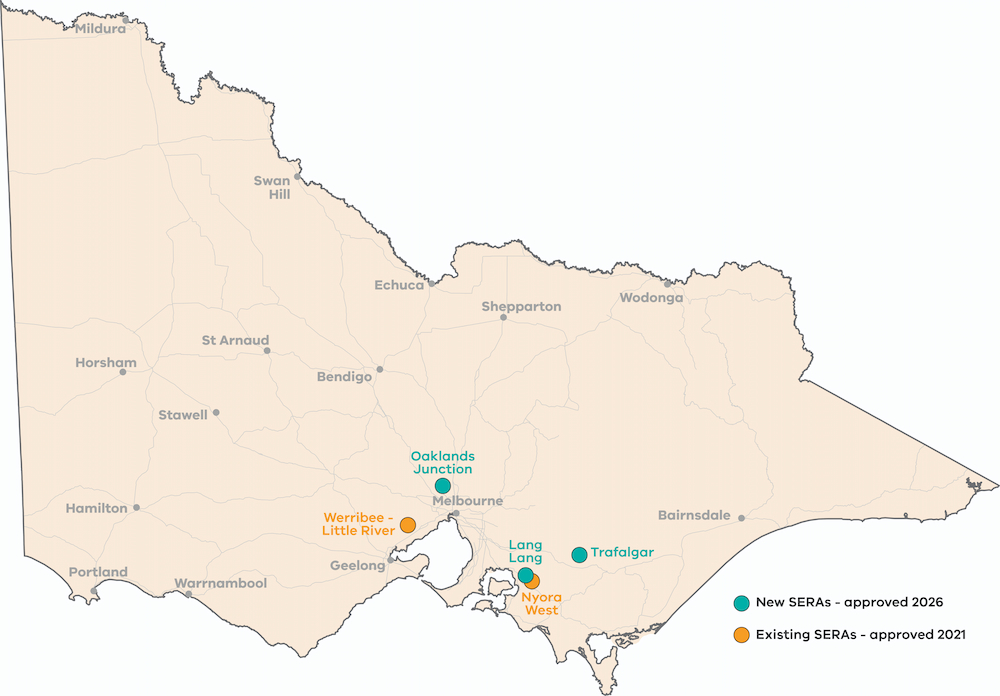
The Minister for Planning approved 3 new SERAs in April 2026. They are located near:
- Lang Lang (Shire of Cardinia)
- Oaklands Junction (City of Hume)
- Trafalgar (Shire of Baw Baw).
Public consultation for these SERAs took place in 2024. More information, fact sheets and FAQs are available on Engage Victoria.
Two existing SERAs were approved in the 2021 pilot. They are located near:
- Nyora West (South Gippsland Shire Council)
- Werribee–Little River (Wyndham Council).
The map below shows the locations of the 5 SERAs (3 new and 2 existing). For a more detailed view of each SERA, visit VicPlan.
Statewide Reserve Inventory Project
The Statewide Reserve Inventory (SRI) is the first of its kind in Australia. It is a detailed database with an interactive dashboard that shows where quarry materials are located and how much is available across Victoria. These reserves are defined as material that is permitted and feasible to extract.
Maintained by Resources Victoria Approvals Coordination, the SRI supports:
- smart investment decisions for the quarry industry
- faster approvals for new quarries in high-demand areas
- planning for affordable housing, roads and other infrastructure
- long-term planning for strategic extractive resource areas (SERAs ).
The interactive dashboard lets users view total reserves in tonnes. You can filter by region or material type (hard rock or sand) to navigate the dashboard.
The SRI also helps government, industry and community plan ahead. It highlights where supply may run short and where new quarries might be needed.
Data collection is ongoing. So far, the SRI includes data covering more than 70% of Victoria’s annual quarry material production. To submit your reserves data, contact Tylah Drochmann, Manager Quarry Approvals: tylah.drochmann@deeca.vic.gov.au.
Page last updated: 17 Jul 2026