Understanding mineral sands in the Wimmera, Mallee and Gippsland
Mineral sands and their uses
Mineral sands contain minerals known as ‘critical minerals’. They are vital in many modern technologies. They are called ‘critical’ because they are important to the economy, but can be hard to access due to where they are found or issues with global supply.
In Victoria, mineral sands commonly contain:
- zircon
- rutile
- leucoxene
- ilmenite
- monazite
- xenotime.
Products and technologies made from mineral sands
Mineral sands are used to make products and technologies we rely on every day.
Rutile, leucoxene and ilmenite contain titanium. Titanium is a strong, light metal with a very high melting point. It is used to make:
- aircraft engines
- spacecraft
- cars
- underwater vehicles
- industrial machinery
- watches
- electric vehicle batteries
- solar cells
- pacemakers
- artificial joints (hips and knees)
- bone pins.
Titanium is also used in paint pigments, paper and plastics. When titanium reacts with oxygen it creates titanium dioxide, a key ingredient of sunscreen.
Zircon is used to make ceramic tiles, and air and water purification systems. It contains zirconium, which is used in:
- dental implants
- hip and knee replacements
- prosthetic devices
- catalytic converters
- surgical tools
- aircraft and spacecraft parts.
Some mineral sands also contain rare earth elements (REEs). These have natural magnetic properties and are used in electric vehicles and wind turbines.
Where mineral sands are found in Victoria
Mineral sand deposits are found in areas that were once ancient seas and rivers.
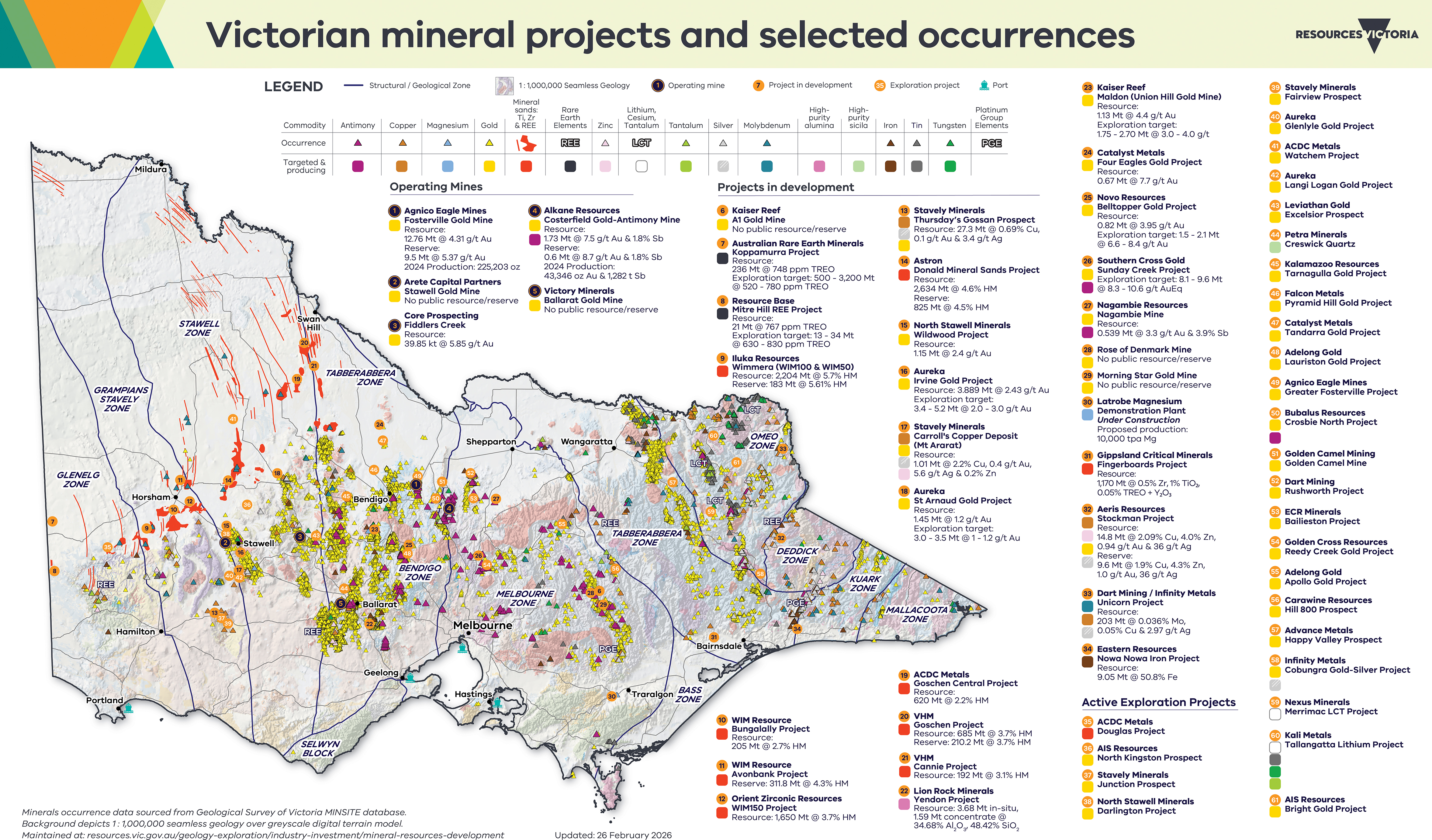
In Victoria, the areas with the highest concentration of deposits are:
- the Murray Basin in the northwest, which includes the Wimmera and Mallee regions
- the Gippsland Basin in the southeast.
Current estimates show that the region contains:
- 22% of Australia’s ilmenite: around 7% of the world’s resources
- 51% of Australia’s rutile: around 32% of the world’s resources
- 39% of Australia’s zircon: around 27% of the world's resources.
The region also has large amounts of monazite and xenotime. These contain REEs such as neodymium, praseodymium, dysprosium and terbium.
How mineral sands are mined
Mineral sands deposits are usually found close to the surface, around 20 to 50 metres below the ground. This depth may vary depending on the location.
In Victoria, mineral sands are mined using dry mining methods. This requires equipment such as trucks, scrapers, excavators and front‑end loaders to dig up the mineral sands from the ground.
The mining process
The process generally involves:
- carefully removing the topsoil
- exposing the mineral sand layer
- mixing the sand with water to create a slurry
- transporting the slurry for refining and processing
- returning stored soil excavated soil (overburden) once mining is complete
- rehabilitating the land so it can be used again for farming or other purposes.
Mineral sands project life cycle
Every project is different, but most mineral sands project follow a similar life cycle, as the below visual shows.
Pre-competitive geoscience

- Geoscience data and modelling used to understand geological framework, prospectivity and potential commodities
- Essential to reduce mineral exploration risk
- New concepts generate new discoveries and potential future production opportunities
- Continuous monitoring and evaluation begins
Exploration

- Licences granted to private sector for mineral exploration
- Mineral exploration is demanding, probability of success can be very low
Discovery

- Determining the potential scale and quality of the resource
- Finding an economically viable resource with consideration of existing post-mining land uses and values
Feasibility

- Identifying a mineral resource that is viable to develop commercially and responsibly
- Planning operation and rehabilitation and conduct baseline assessments
- Decision to progress to mine approval
Mine approval

- Meeting regulatory and planning approvals
Development
- Accessing site and construct mine infrastructure
Operation/production
- Mining operation and production
- Economic growth, jobs and royalties
Processing

- Separating and refining for use in products and technologies
Recycling

- Recycling feeds material back into processing
Manufacturing

- Manufacturing products using refined minerals and materials
Care and maintenance begins
- Progressively restoring mined land and the environment
Decommissioning

- Removing mine infrastructure
Rehabilitation and closure
- Exploring innovative uses for land once mining has finished
- Constructing safe, stable and sustainable landform
Post-closure management

- Long-term monitoring and management to ensure enduring safe, stable and sustainable landform
Find out more about how mineral sands are mined
We provide regular updates on all quarrying, exploration and mining activities within the state, as well as comprehensive information on all current mineral projects and operations.
Page last updated: 22 May 2026